A survey grid, flown
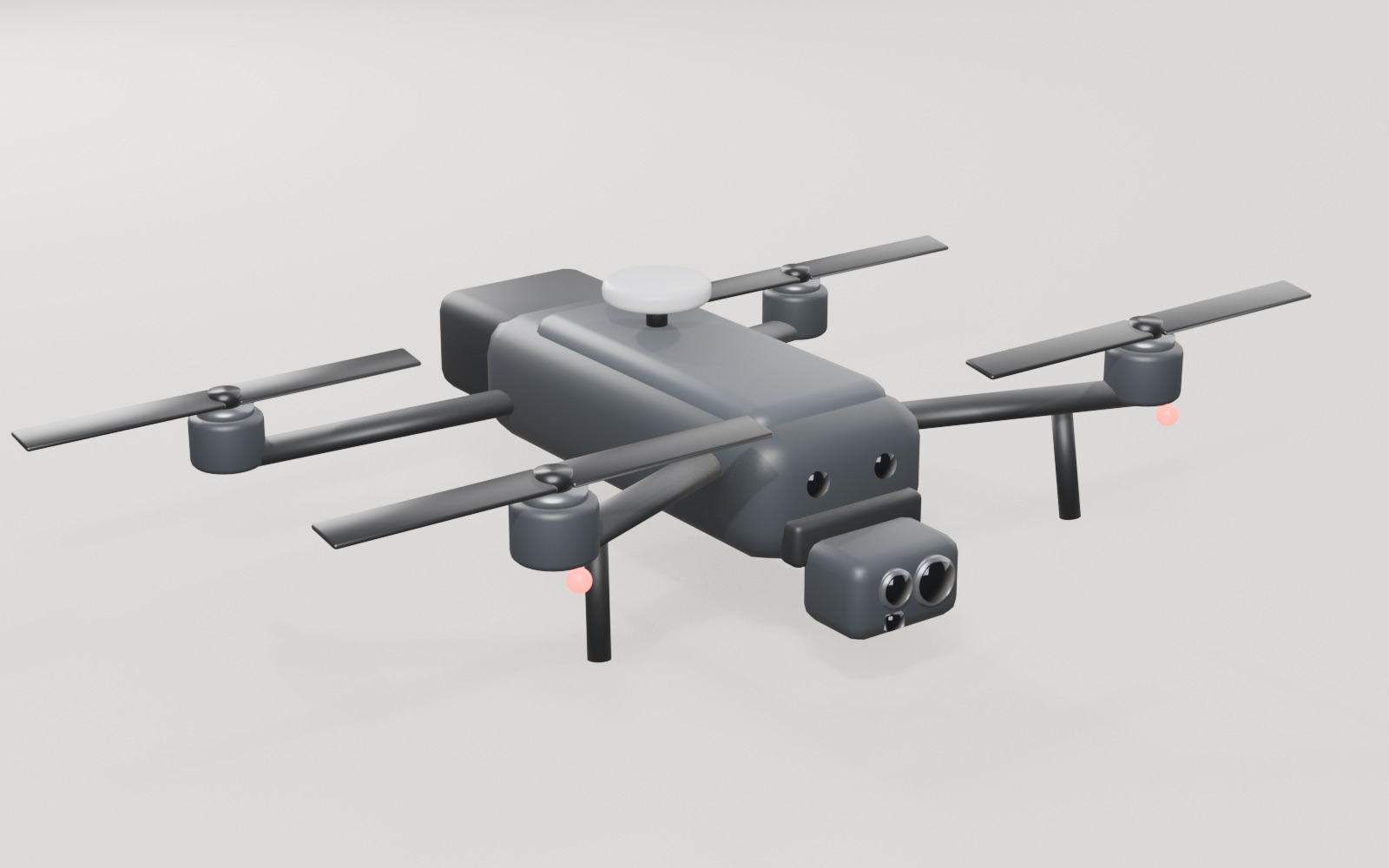
A Matrice-class drone, modelled in Blender, flies five lanes and fires the camera every Δ metres. Orange: ground in each photo. Overlap is what reconstruction needs.
s(t) = L·E(t/T)
Drag to orbit, scroll to zoom. 4× time-lapse; tilt drawn 3× life size.
Easing, velocity, tilt
E(u)E′(u) / 3
\[ \begin{aligned} s(t) &= L\,E(t/T) \\ v(t) &= \tfrac{L}{T}\,E'(t/T) \\ a(t) &= \tfrac{L}{T^2}\,E''(t/T) \end{aligned} \]
inOutSine: \(E(u) = \tfrac{1-\cos \pi u}{2}\), peak speed \(\tfrac{\pi}{2}\tfrac{L}{T}\) mid-leg. Tilt \(\theta = \arctan(a/g)\).
\[ \begin{aligned} w_{\perp} &= 2h\tan\tfrac{\varphi}{2}, \quad w_{\parallel} = \tfrac34 w_{\perp} \\ \Delta &= w_{\parallel}(1-o_f) \\ S &= w_{\perp}(1-o_s) \end{aligned} \]- Altitude h
- —
- Ground speed v
- —
- Acceleration a
- —
- Body tilt θ
- —
- Leg progress u
- —
- Peak v this ease
- —
- Footprint w⊥ × w∥
- —
- Trigger spacing Δ
- —
- Lane spacing S
- —
- Photos taken
- 0